
Virtual View Windows
Window Replacement Baltimore, MD
Window Replacement Baltimore, Maryland: Serving Row Houses, Colonials, and Every Home Between
Baltimore is a city of extraordinary architectural range. Federal row houses in Fells Point and Federal Hill. Queen Anne Victorians in Bolton Hill and Reservoir Hill. Mid-century colonials in Towson, Catonsville, and Dundalk. Contemporary new construction in Harbor East and around the Inner Harbor redevelopment corridor. Each housing type in the Baltimore metro brings its own window replacement requirements, its own permit considerations, and its own set of performance demands created by the Chesapeake region’s combination of hot, humid summers and cold, damp winters.
At Virtual View Windows, we deliver professional window replacement for Baltimore and the broader metro built around the specific realities of this market: CHAP historic district review for applicable properties, BGE EmPOWER and Maryland energy rebate program documentation, Baltimore’s row house window profile requirements, and the heat-and-moisture-resistant materials that Angi’s Baltimore market research specifically recommends for this climate.
From South Baltimore and Charles Village to Towson, Catonsville, and Anne Arundel County, we are the window replacement near you that Maryland homeowners trust for precision installation backed by a lifetime warranty and no payment until every window passes your inspection.
How Virtual View Windows Handles Every Baltimore Window Replacement
Our Baltimore process addresses the specific CHAP, permit, and row house requirements that make window replacement in this city different from a generic window project.
Step 1: Free Estimate and CHAP Screening
Contact Virtual View Windows online or by phone. We gather your window count, approximate sizes, and your address. We immediately determine whether your property falls within a CHAP local historic district or is a designated local landmark. You receive a detailed written estimate typically within one business day.
Step 2: CHAP Pre-Consultation (Where Applicable)
For properties in CHAP local historic districts, we initiate the CHAP pre-consultation process concurrently with your product selection. We review CHAP's design guidelines for your specific historic district, identify which replacement window products satisfy both CHAP visual character requirements and Maryland energy code performance standards, and assist with the Certificate of Appropriateness application. Installation does not proceed until CHAP approval is received.

Step 3: Product Selection and Energy Performance Verification
You finalize your window style, frame material, glass package, and hardware. We confirm every product meets Maryland's energy code U-factor requirement and identify which products qualify for ENERGY STAR Most Efficient certification (required for the enhanced federal tax credit starting tax year 2025). We explain the documentation we provide for BGE EmPOWER rebates and federal tax credit filing.
Step 4: Baltimore City or County Permit Filing
When your project requires a building permit, we submit the application to the appropriate authority before scheduling your installation date. For Baltimore City properties, we work with Baltimore City's Department of Housing and Community Development. For Baltimore County properties, we coordinate with the county building department. We notify you when permits are approved.
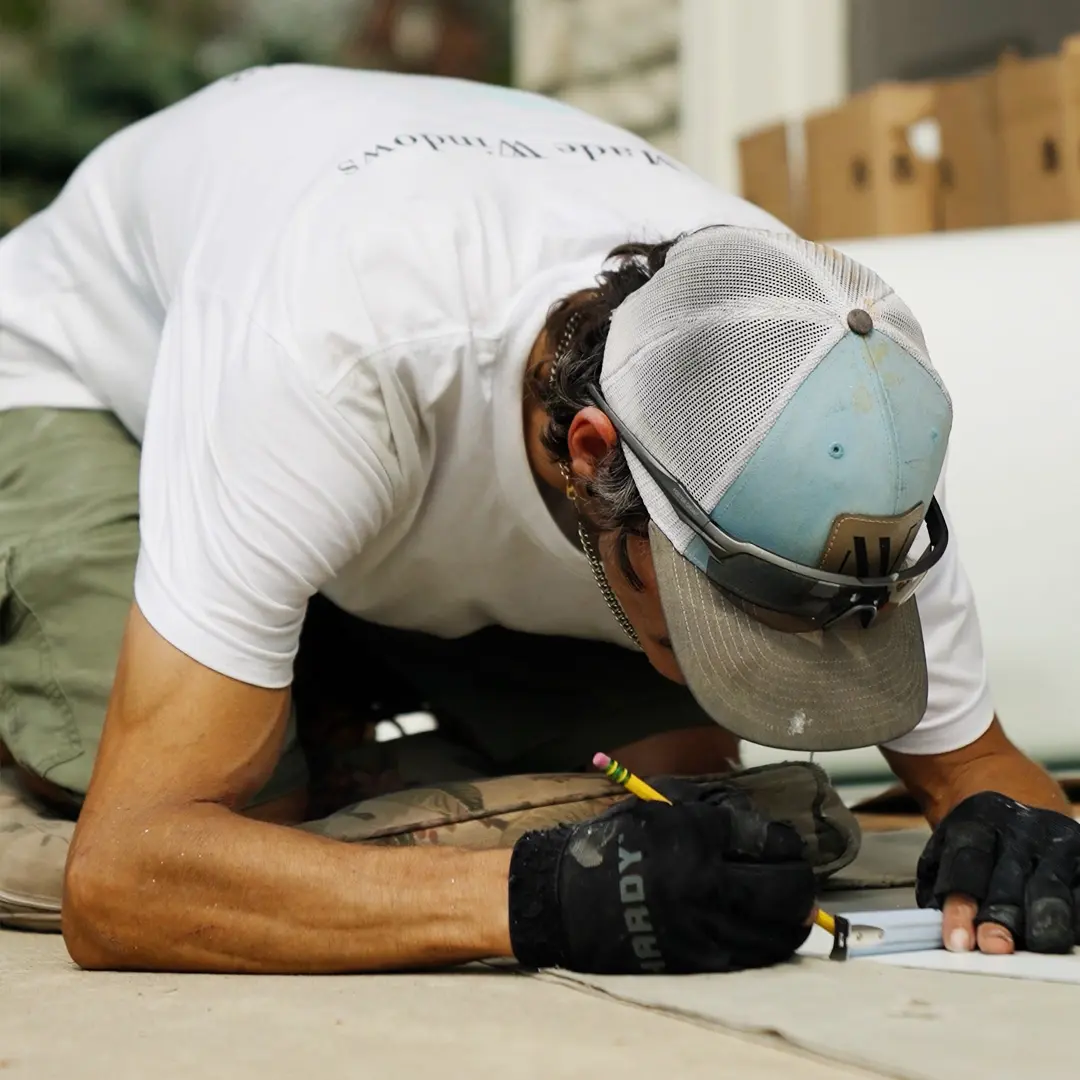
Step 5: Installation Day
Our certified installation crew arrives with all tools, flashing materials, humidity-grade sealants, and trim supplies appropriate for Baltimore's climate. We remove existing windows, inspect each rough opening for the moisture damage and deterioration common in Baltimore's older housing stock, and install your new windows to manufacturer specifications and Maryland energy code air-sealing requirements. Most Baltimore projects of 8 to 12 windows in a row house or small colonial are completed in one day.
Baltimore Window Replacement Market Data and Statistics for 2025
Here is what current market research from Baltimore City, Baltimore County, and Maryland-specific sources shows for homeowners considering window replacement in 2025.
$369-$499 | Average cost Baltimore City County homeowners paid for replacement window installation in 2025. Source: Manta Baltimore City County, 2025 |
$335-$452 | Average cost for window glass replacement in Baltimore City. Source: Manta Baltimore City 2025 (glass replacement category) |
$630 avg. | Average per-window replacement cost in Baltimore, Maryland. Source: Angi Baltimore, July 2025 |
$6,006 avg. | Average total window replacement project cost in Baltimore. Range: $3,447 to $8,591. Source: Angi Baltimore, July 2025 |
15% below nat. | Baltimore window replacement costs are over 15% below the national average. Source: Angi Baltimore, July 2025 |
$4,530-$5,540 | Average cost to replace 8 windows in Baltimore (typical row house count). Source: Angi Baltimore, July 2025 |
$5,040-$15,680 | Full project range for standard window replacement scope in Baltimore. Typical estimate $8,960. Source: Project Cost Atlas Baltimore, December 2025 |
$4,982 std. | Standard whole-home window replacement project cost. Based on 291 completed Baltimore-area projects. Source: Homeyou Baltimore, 2025 |
$375-$506 | Most homeowners paid $375 to $506 per window on replacement projects in Baltimore. Source: Homeyou Baltimore, 2025 |
$550-$950 | Common per-window range for standard windows in the Baltimore area. Higher labor costs push prices above average. Source: Advantage Home Exteriors, 2025 |
$300-$1,000 | Per-window cost range for Maryland homeowners replacing windows. Source: ACM Window and Door Design Baltimore, 2025 |
$100-$300 | Installation labor cost per window in Baltimore. Source: Angi Baltimore, July 2025 |
$50-$200 | Permit application and fee range for window replacement in Baltimore historic districts. Source: Angi Baltimore, July 2025 |
70-85% ROI | Average return on investment for window replacement in Baltimore, Maryland. Source: Angi Baltimore, July 2025 |
Up to 40% | Potential energy cost savings from replacing old windows with new efficient units. Source: Homeyou Baltimore, 2025 |
$200-$400/yr | Annual energy bill savings for Maryland homeowners with ENERGY STAR window replacement. Source: Thompson Creek / U.S. Department of Energy |
Window Replacement Styles for Baltimore Homes
Baltimore’s architectural diversity calls for a broad range of replacement window styles. Virtual View Windows installs every major window type, custom-ordered to your exact rough opening dimensions and appropriate for your home’s architectural character.
Baltimore’s dominant window style across both historic row houses and suburban colonials. Both sashes tilt inward for interior cleaning, which is particularly valuable in Baltimore’s attached row houses where exterior window access is impossible on shared walls. Angi Baltimore documents that double hung windows are the most common replacement style in the Baltimore metro. Available in vinyl, fiberglass, and wood profiles to suit both standard homes and CHAP-reviewed historic properties. Cost runs $400 to $500 installed for standard vinyl per HomeBlue’s Baltimore market data.
Side-hinged and crank-operated, casement windows seal tightly against their frame when closed, providing superior air infiltration resistance in Baltimore’s humid environment. A strong choice for mid-century suburban homes in Catonsville, Towson, and Dundalk and for locations where maximizing ventilation from Baltimore’s prevailing summer breezes is a priority.
Baltimore’s Victorian, Federal, and Italianate homes contain transoms, arched heads, and decorative shapes that require custom manufacturing for correct replacement. Virtual View Windows sources specialty shape windows for these openings, including products that satisfy CHAP design guidelines for properties in local historic districts.
Bay windows project outward from the wall plane, combining a central fixed unit with flanking operable sashes. They are among the most architecturally significant features of Baltimore’s historic stock, particularly in the Queen Anne and Federal Revival homes common in the city’s older neighborhoods. Proper bay window replacement in Baltimore requires careful CHAP review for historic properties and precise flashing at the projecting roof plane to prevent the moisture infiltration that is common in poorly installed bay window units in this humid climate.
Many Baltimore properties in Bolton Hill, Mount Vernon, and other pre-1900 neighborhoods feature bay windows, curved glass panes, or divided-light configurations characteristic of the Queen Anne and Late Victorian architectural periods. Angi Baltimore specifically notes that Queen Anne and Late Victorian-style historical homes commonly feature larger bay windows that cost more to replace. Virtual View Windows sources historically appropriate replacements for these openings, including CHAP-compliant products for designated historic properties.
Fixed-frame non-operable windows maximize light and views without air or moisture infiltration. Particularly valued in Baltimore homes with views of the harbor, the Chesapeake, or parkland. Picture windows deliver the lowest air infiltration of any window style, making them an excellent energy performance choice for large wall openings.
Awning windows are top-hinged and open outward, allowing ventilation during Baltimore’s frequent rain events without water entry. Hopper windows hinge at the bottom and are commonly used in basements across Baltimore’s older housing stock. Both styles are available in vinyl and fiberglass in standard and custom sizes.
Why Baltimore's Housing Stock Creates Distinct Window Replacement Challenges
Baltimore is nationally recognized for one of the highest proportions of attached row houses of any American city. Angi’s Baltimore market analysis specifically notes that Baltimore’s high proportion of attached row houses means the typical home has fewer windows than a detached suburban home. A traditional 19th-century working-class row house in South Baltimore or Hampden features narrower windows, especially on the side and rear elevations, and specific frame profiles tied to the architectural period.
This housing context shapes window replacement in three specific ways that a window company unfamiliar with Baltimore cannot navigate effectively.
Baltimore’s historic row houses were built across a century of residential construction from the 1840s through the 1940s, each decade producing slightly different window proportions, frame depths, and rough opening dimensions. Replacing windows in a Federal row house in Fells Point requires different product knowledge than replacing windows in a Craftsman-influenced row house in Reservoir Hill or a 1920s brick semi-detached in Govans. Virtual View Windows measures each rough opening individually and orders windows that match the historical proportions of your home’s specific construction era, rather than forcing standard catalog sizes into openings they were not designed to fill.
Hot, Humid Summers and Chesapeake Winter Cold
Baltimore’s climate sits at the transition between the Mid-Atlantic coast’s hot, humid summers and the Northeast’s cold winter pattern. The Chesapeake Bay moderates temperature extremes to a degree, but Baltimore homeowners still face July heat indexes above 100 degrees, persistent summer humidity that exceeds 80 percent relative humidity on many days, and winters that bring sustained cold and occasional ice storms. Angi’s Baltimore market research specifically recommends investing in heat-and-moisture-resistant window materials to promote longevity in this climate. The practical implications are direct: vinyl frames that resist humidity-related expansion and contraction, Low-E glass that limits summer solar heat gain, and comprehensive exterior flashing that prevents moisture infiltration during Baltimore’s persistent rain events.
Baltimore has one of the most active historic preservation programs of any American city. The Commission for Historical and Architectural Preservation (CHAP) reviews exterior changes to properties in Baltimore’s local historic districts and local landmark properties. Window replacement that alters the appearance of a historic property visible from a public right of way requires CHAP approval before work can proceed. Angi specifically notes that historically designated homes in Baltimore may incur higher window replacement costs to meet CHAP standards. Virtual View Windows guides Baltimore homeowners through the CHAP pre-review process and assists with product selection that satisfies both CHAP’s design guidelines and modern energy performance requirements.
Why Baltimore Homeowners Choose Virtual View Windows
Baltimore has dozens of window replacement companies competing for city and county business. The companies that consistently deliver on Baltimore’s specific requirements handle CHAP compliance without delays, understand row house window proportions, specify heat-and-moisture-resistant materials for the Chesapeake climate, and document BGE rebate requirements correctly. Here is what Virtual View Windows brings to every Baltimore project.
Row House Window Expertise
We have measured and replaced windows in Baltimore’s Federal row houses, Italianate row houses, and early 20th-century brick semi-detacheds. We understand the narrow side window profiles, the deeper rough openings common in pre-war construction, and the limited interior access that characterizes many Baltimore attached homes. Row house window replacement in Baltimore requires a different level of site-specific attention than a detached suburban home, and our installation teams bring that knowledge to every city project.
CHAP District Experience
Virtual View Windows is familiar with CHAP’s design guidelines for Baltimore’s local historic districts and assists homeowners in identifying replacement window products that satisfy both CHAP’s visual character requirements and modern energy performance standards. We initiate the CHAP pre-consultation process early in your project to avoid the delays that occur when windows are ordered before COA approval is secured.
Chesapeake Climate Specification
Angi’s Baltimore research specifically recommends heat-and-moisture-resistant frame materials for Baltimore’s combination of hot, humid summers and cold, damp winters. We specify vinyl and fiberglass frames that resist Baltimore’s humidity-driven expansion and contraction cycles, Low-E glass coatings tuned for the Mid-Atlantic’s solar profile, and warm-edge spacer systems that protect seal integrity through Baltimore’s freeze-thaw events.
BGE EmPOWER and Maryland Rebate Documentation
BGE customers in Baltimore may qualify for rebates through the EmPOWER Maryland program for ENERGY STAR-certified window replacement as part of a comprehensive home energy upgrade. Maryland’s HERO and HEAR programs, expected to launch statewide in 2025 and 2026, will add additional rebate opportunities. Virtual View Windows provides NFRC labels, manufacturer certification statements, and itemized invoices at project completion for all rebate applications.
Written Estimates Without High-Pressure Sales
Baltimore homeowners deserve transparent, itemized pricing without same-day decision pressure. Virtual View Windows delivers accurate written estimates that reflect real Baltimore labor rates and product costs, with no payment until every window is installed and approved. We provide our estimates quickly, often within one business day, without requiring an in-home sales appointment.
Lifetime Warranty on Labor and Materials
Every Baltimore window replacement project Virtual View Windows completes is covered by a lifetime warranty on both the installed product and our workmanship. Baltimore’s climate tests every window installation over time through summer humidity, winter cold, and the persistent moisture that characterizes the Chesapeake region. Our warranty is built for that long-term demand.
CHAP Historic District Review and Baltimore Window Replacement Permits
Baltimore’s window replacement regulatory environment has three components that affect different properties across the city: CHAP review for historic district properties, Baltimore City or County building permits, and Maryland’s energy code requirements for replacement windows.
Baltimore Commission for Historical and Architectural Preservation (CHAP)
- Frame material: Vinyl is the most budget-friendly. Fiberglass and wood-clad carry higher upfront costs with longer lifespans.
- Glass package: Low-E double-pane is standard. Triple-pane adds $150 to $350 per window.
- Window style and size: Bay, bow, and specialty shapes cost significantly more than standard rectangles.
- Floor level access: Upper-story windows require additional labor time and may require staging.
- Structural condition: Rotted or damaged rough openings require repair prior to installation.
- Permit fees: Raleigh requires a permit for window replacement. Virtual View Windows handles the application on your behalf.
- Project size: Larger whole-home replacement projects generally reduce per-window cost.
CHAP Historic District Review and Baltimore Window Replacement Permits
Baltimore’s window replacement regulatory environment has three components that affect different properties across the city: CHAP review for historic district properties, Baltimore City or County building permits, and Maryland’s energy code requirements for replacement windows.
Baltimore Commission for Historical and Architectural Preservation (CHAP)
CHAP administers Baltimore’s local historic district program, which includes dozens of designated neighborhoods across the city. Properties within CHAP local historic districts or designated as local landmarks are subject to exterior design review for changes visible from a public right of way. Window replacement that changes the appearance of a historic property, including changes to frame material, profile, color, configuration, or glazing pattern, requires a Certificate of Appropriateness (COA) from CHAP before work can legally proceed.
CHAP’s review process is distinct from Maryland’s State Historic Preservation Office (SHPO) review, which applies to National Register properties seeking federal tax credits. CHAP focuses specifically on local historic designation. Baltimore’s historic districts include Fells Point, Federal Hill, Bolton Hill, Mount Vernon, Otterbein, Ridgely’s Delight, and others. Properties in these neighborhoods should confirm CHAP applicability before ordering replacement windows.
Property Type | Approval Required | What Virtual View Windows Does |
Standard Baltimore City home (no CHAP) | Baltimore City building permit when opening size changes. Like-for-like typically exempt. | Confirms permit requirement for your address. Files application when required. |
CHAP local historic district property | Certificate of Appropriateness from CHAP before ordering. Review may specify frame material, profile, glazing pattern. | Reviews CHAP design guidelines for your district. Guides product selection meeting COA requirements. Assists with COA application. |
Baltimore County property | Baltimore County building permit. Separate from Baltimore City jurisdiction. | Confirms correct permit authority for your specific county address. Handles application. |
National Register property (federal tax credit) | SHPO review for 20% federal historic tax credit projects. Different from CHAP local review. | Can advise on SHPO-compatible products. Tax credit claiming requires separate legal/accounting consultation. |
Maryland Energy Code Requirements for Replacement Windows
Maryland’s residential energy code establishes minimum performance requirements for replacement windows. For the Baltimore metro area’s climate zone (IECC Zone 4), replacement windows must meet a maximum U-factor of 0.30 to qualify as energy-compliant. Windows meeting ENERGY STAR Most Efficient certification (generally triple-pane with advanced Low-E coatings) qualify for enhanced federal tax credit benefits starting tax year 2025. Virtual View Windows installs only products that meet Maryland’s energy code requirements and provides NFRC documentation confirming performance at project completion.
BGE EmPOWER, Maryland Rebates, and Energy Incentives for Baltimore Homeowners
Baltimore homeowners have access to a layered set of energy efficiency incentives for window replacement that makes qualifying projects significantly more affordable. Here is the complete 2025 picture from federal, state, and utility-level programs.
Baltimore Gas and Electric serves most of the Baltimore metro area. BGE’s Home Performance with ENERGY STAR program provides rebates for energy-efficient home upgrades, including window replacements, contingent on a whole-home energy audit by a Home Performance with ENERGY STAR contractor. Thompson Creek documents BGE rebates of up to $250 for qualifying ENERGY STAR windows as part of comprehensive home energy upgrades. BGE also offers the BeSMART Energy Efficiency Financing program with unsecured loans of up to $30,000 at a 4.99 percent fixed interest rate for energy improvements, and Energy Finance Solutions loans up to $15,000 at rates beginning at 8.49 percent. The Maryland Clean Energy Advantage Loan Program was extended through December 31, 2025.
To access BGE Home Performance rebates, you must: be a BGE residential electric or natural gas customer, have a home energy audit completed by an HPwES contractor, and have the qualifying upgrades completed by an HPwES-certified contractor. Virtual View Windows can connect Baltimore homeowners with HPwES-certified audit providers and provide the documentation required for BGE rebate applications at project completion.
Maryland HERO and HEAR Programs
Maryland submitted its application in late 2024 for federal funding to launch two major rebate programs through the Inflation Reduction Act. The Home Efficiency Rebates (HERO) program will offer up to $8,000 in rebates for energy efficiency improvements that achieve 20 to 35 percent whole-home energy savings. The High-Efficiency Electric Home Rebate Act (HEAR) program will offer up to $14,000 for qualifying electrification and efficiency projects for low-to-moderate income households. These programs are expected to launch in 2025 and 2026. Thompson Creek’s analysis notes that the combination of federal tax credits, state programs, and utility rebates can cover up to 30 to 40 percent of total window replacement investment for qualifying Baltimore homeowners.
Federal Energy Efficient Home Improvement Credit
Baltimore homeowners who complete qualifying ENERGY STAR window replacement can claim the federal Energy Efficient Home Improvement Credit on their federal taxes. Important 2025 updates apply:
- For installations completed in 2024: Standard ENERGY STAR certification was sufficient to qualify.
- Starting tax year 2025: Windows must earn ENERGY STAR Most Efficient certification, which generally requires triple-pane windows with advanced Low-E coatings and insulated frames.
- Starting tax year 2025: Homeowners must include the window’s Product Identification Number (PIN) on their tax return.
- Credit amount: Up to 30 percent of installed cost, maximum $600 per year for windows.
- Current law through 2032: Provides long-term planning window for Baltimore homeowners.
Virtual View Windows provides NFRC documentation, manufacturer certification statements, ENERGY STAR labels, and Product Identification Numbers for all qualifying window replacements at project completion.
Maryland EmPOWER and Utility Programs
- Pepco: Home Performance rebates for residential customers in areas served by Pepco, including parts of the Baltimore metro.
- Delmarva Power: Home Performance rebates for qualifying ENERGY STAR window replacements in Delmarva service areas.
- Potomac Edison: Rebates through EmPOWER Maryland for eligible energy efficiency upgrades including windows.
- Shop Maryland Energy Weekend: Annual three-day period in February when Maryland sales tax does not apply to certain ENERGY STAR products. Check current eligibility at marylandtaxes.gov.
Window Frame Materials for Baltimore's Mid-Atlantic Climate
Angi’s Baltimore research recommends investing in heat-and-moisture-resistant window frame materials to maximize longevity in the Baltimore climate. Here is how the primary options compare for Chesapeake region conditions.
Vinyl: Baltimore's Volume Standard
Vinyl dominates Baltimore’s window replacement market by volume. Vinyl frames resist Baltimore’s humidity cycles, never require painting, and maintain their dimensional stability through the Chesapeake region’s temperature swings from January lows near 25 degrees to July heat indexes above 100. Cost runs $400 to $500 installed for a standard double hung window in Baltimore per HomeBlue’s market data. Vinyl lifespan in Baltimore’s climate is typically 20 to 40 years. For CHAP properties, vinyl is sometimes acceptable in rear elevations not visible from public rights of way but may be restricted on primary street-facing facades. Confirm CHAP applicability for your specific address.
Fiberglass: Heat and Moisture Leadership
Angi Baltimore specifically recommends fiberglass as a heat-and-moisture-resistant material for Baltimore’s demanding climate. Fiberglass frames expand and contract less than vinyl across Baltimore’s temperature range and resist moisture-related deterioration better over the long term. Fiberglass accepts exterior paint and can be manufactured in profiles that satisfy CHAP visual character requirements for historic districts. Cost runs approximately $650 to $1,200 per window installed in Baltimore. Lifespan in Chesapeake conditions commonly reaches 30 to 50 years.
Wood and Wood-Clad: Baltimore's Historic Neighborhoods
Wood windows remain the preferred material for many CHAP-reviewed properties in Baltimore’s local historic districts. CHAP design guidelines for most Baltimore historic districts strongly favor wood or wood-clad replacement windows for street-facing elevations. Cost runs $600 to $900 for standard wood double hung windows per HomeBlue’s Baltimore market data. Wood-clad windows with aluminum or fiberglass exterior shells eliminate the exterior maintenance burden while preserving wood’s interior character and its suitability for CHAP review. Virtual View Windows guides Baltimore historic homeowners through product selection that satisfies both CHAP and Maryland energy code requirements simultaneously.
Glass Package Specifications for Baltimore's Climate Zone
Baltimore falls within IECC Climate Zone 4 (Mixed-Humid). Here are the performance specifications that matter most for replacement windows in this region:
- U-Factor: Maximum 0.30 for energy code compliance in Baltimore’s climate zone. High-performance double-pane targets U-0.27 or better.
- Solar Heat Gain Coefficient: 0.25 or below recommended to limit Baltimore’s intense summer solar heat gain during the extended Chesapeake cooling season.
- Low-E Coating: Standard on all energy-efficient Baltimore window replacements. Reduces summer solar heat transmission and protects interior finishes from UV degradation.
- Argon Gas Fill: Standard between panes on all certified products. Reduces conductive heat transfer compared to air.
- Triple-Pane: U-factor as low as 0.15. Required for ENERGY STAR Most Efficient certification starting 2025 tax year. Recommended for Baltimore homes near I-95, I-695, or the BWI airport corridor for combined thermal and noise performance.
Window Replacement Cost in Baltimore, Maryland
Window replacement cost in Baltimore, Maryland is over 15 percent below the national average according to Angi, making Baltimore one of the more favorable major metro markets in the country for homeowners planning replacement projects. Here are current benchmarks from multiple Baltimore-specific sources.
Window Type and Material | Low (Installed) | High (Installed) |
Vinyl double hung (standard) | $400 | $500 |
Vinyl double hung (Baltimore metro avg.) | $369 | $499 |
Wood double hung (standard) | $600 | $900 |
Fiberglass double hung | $650 | $1,200 |
Per-window average, Baltimore metro | $550 | $950 |
Bay or Bow Window (historic proportions) | $1,200 | $4,000+ |
CHAP-compliant wood or clad window (premium) | $900 | $2,000+ |
Triple-Pane upgrade (add per window) | +$150 | +$400 |
Specialty / Victorian shape / arched | $600 | $2,500+ |
Permit fee (when required) | $50 | $200 |
Whole-Home Window Replacement Estimates for Baltimore Homes
Project Scope | Low Estimate | High Estimate |
8 windows, typical Baltimore row house (vinyl) | $3,800 | $5,540 |
10 windows, 1,000 sq ft Baltimore home (vinyl) | $3,800 | $4,800 |
15 windows, 1,500 sq ft suburban home (vinyl) | $5,700 | $7,200 |
20 windows, 2,000 sq ft colonial (vinyl) | $7,600 | $9,600 |
Complete project, Baltimore metro range | $5,040 | $15,680 |
What Drives Baltimore Window Replacement Pricing
- Number of windows: Row houses typically have 8 windows on the lower end. Larger suburban colonials and Queen Anne-style homes may have 12 to 20 or more.
- Frame material: Vinyl is the most affordable. Fiberglass ($650 to $1,200) and CHAP-compliant wood or wood-clad products carry higher costs.
- CHAP compliance: Historic district properties requiring CHAP-approved products add material cost and project timeline. COA application fees run $50 to $200 per Angi Baltimore.
- Window style: Bay, bow, and Victorian specialty shapes cost significantly more than standard rectangles. Angi notes that Queen Anne row houses with large bay windows face higher replacement costs.
- Glass package: Standard double-pane Low-E with argon is the baseline. Triple-pane (required for ENERGY STAR Most Efficient) adds $150 to $400 per window.
- Floor level: Upper-floor windows add labor time. Baltimore’s attached row houses can present staging challenges on upper floors.
- Permit fees: $50 to $200 when required per Angi Baltimore, plus any CHAP COA fees.
Frequently Asked Questions About Window Replacement in Baltimore, Maryland
How much does window replacement cost in Baltimore, Maryland?
Window replacement in Baltimore averages $630 per window and $6,006 for a complete project per Angi’s July 2025 Baltimore data, making Baltimore over 15 percent below the national average. Manta’s 2025 Baltimore City County data shows most homeowners paid $369 to $499 per window. HomeBlue documents $400 to $500 for standard vinyl double hung installation. Whole-home projects range from $3,800 to $4,800 for 10 standard vinyl windows to $5,700 to $7,200 for 15 windows. Row houses typically have 8 windows on the lower end of the range per Angi, keeping total project costs under the suburban home average. CHAP-compliant historic district materials and bay window replacements add cost above these baselines. Virtual View Windows provides free written estimates with no payment until installation is complete.
Do Baltimore window replacement projects require CHAP approval?
Window replacement in CHAP local historic districts in Baltimore requires a Certificate of Appropriateness before work on exterior changes visible from a public right of way can legally proceed. CHAP’s local historic districts include Fells Point, Federal Hill, Bolton Hill, Mount Vernon, Otterbein, and others. CHAP review applies to Baltimore’s locally designated properties and districts, which is separate from National Register listing. The review evaluates frame material, profile, configuration, and glazing pattern. Permit application and fees for CHAP-related window replacement in Baltimore range from $50 to $200 per Angi Baltimore data. Virtual View Windows initiates the CHAP pre-consultation process before ordering windows for applicable properties.
What type of windows are best for Baltimore, Maryland homes?
Angi’s Baltimore market research specifically recommends investing in heat-and-moisture-resistant window materials to promote longevity in Baltimore’s combination of hot, humid summers and cold, damp winters. Fiberglass frames are the most heat-and-moisture-resistant per Angi Baltimore. High-quality vinyl is the recommended cost-effective alternative. For CHAP historic district properties, wood or wood-clad frames in approved colors may be required or preferred for street-facing elevations. On glass performance, Baltimore’s IECC Climate Zone 4 calls for a maximum U-factor of 0.30, SHGC of 0.25 or below for summer solar management, and standard Low-E coating with argon fill. Triple-pane with U-factor as low as 0.15 is recommended for homes near I-95, I-695, or BWI.
Can I get BGE rebates for window replacement in Baltimore?
BGE customers in the Baltimore metro may qualify for rebates through the EmPOWER Maryland Home Performance with ENERGY STAR program for qualifying ENERGY STAR window replacement as part of a comprehensive home energy upgrade. Thompson Creek documents BGE rebates of up to $250 for qualifying ENERGY STAR windows contingent on a whole-home energy audit by an HPwES contractor. BGE also offers BeSMART financing at 4.99 percent fixed for energy improvements up to $30,000, and Energy Finance Solutions loans up to $15,000. Maryland’s HERO program (up to $8,000) and HEAR program (up to $14,000 for qualifying households) are expected to launch statewide in 2025 and 2026. Virtual View Windows provides all required NFRC and ENERGY STAR documentation for BGE and Maryland rebate applications.
What is the return on investment for window replacement in Baltimore?
Angi Baltimore documents an average return on investment of 70 to 85 percent for window replacement in Baltimore, Maryland. The exact return depends on frame and glazing materials, installation quality, and the condition of the rest of the home’s exterior. In energy savings, Maryland homeowners with ENERGY STAR window replacement save $200 to $400 per year according to Thompson Creek and U.S. Department of Energy data. Homeyou Baltimore documents up to 40 percent reduction in energy costs when replacing old windows with efficient units. Window replacement consistently ranks in the top five home improvement projects by ROI according to Homeyou Baltimore, making it one of the most financially sound investments for Baltimore homeowners planning to sell or seeking long-term comfort improvements.
Baltimore City Neighborhoods and Metro Communities We Serve
- Baltimore City neighborhoods: Fells Point, Federal Hill, South Baltimore, Charles Village, Bolton Hill, Mount Vernon, Reservoir Hill, Hampden, Remington, Govans, Roland Park, Homewood, Highlandtown, Locust Point, Canton, Patterson Park
- Baltimore County communities: Towson, Catonsville, Dundalk, Essex, Parkville, White Marsh, Pikesville, Owings Mills, Cockeysville, Hunt Valley, Lutherville, Timonium
- Surrounding counties: Anne Arundel County (Annapolis, Glen Burnie, Pasadena), Howard County (Columbia, Ellicott City), Carroll County, Harford County

Get Your Free Estimate Today | Call or Request Online | Serving All of Baltimore
Window Services Near You Across Baltimore and the Metro Region
Baltimore’s neighborhoods have very different window replacement realities. A Federal row house in Fells Point in a CHAP local historic district requires a different process than a 1960s colonial in Catonsville or a new construction townhouse in Harbor East. Finding window services near you in Baltimore that handles all of those scenarios with the right products, the right permits, and the right installation expertise is the real challenge in this market.
Virtual View Windows is a window replacement company with direct accountability to every Baltimore City and Baltimore County homeowner we serve. We are not a national franchise routing calls to subcontractors in Maryland. We understand row house window proportions. We know which neighborhoods fall under CHAP jurisdiction. We document BGE EmPOWER rebate requirements correctly. And we back every project with a lifetime warranty that holds through every Baltimore summer and winter.
Finding window replacement near you in Baltimore that combines CHAP expertise, BGE rebate documentation, Maryland energy code compliance, and row house installation knowledge under a single point of contact is exactly what Virtual View Windows delivers. The process starts with a free estimate, includes CHAP pre-consultation for applicable properties at no charge, and ends with complete documentation for every energy rebate and tax credit your project qualifies for.
Baltimore’s housing market has shown resilience across economic cycles, supported by the city’s institutional anchor employers, the Inner Harbor economy, and the strength of established suburban communities like Towson, Catonsville, and Howard County’s Columbia. Window replacement from a qualified local company consistently ranks among the top-performing home improvement investments in the Mid-Atlantic region by return on investment, and Baltimore’s 15 percent below national average construction costs make this market particularly favorable for homeowners planning projects in 2025.
Baltimore is a city with more architectural history per block than almost any other American city, and the homes in every neighborhood, from the Federal row houses of Fells Point to the brick colonials of Towson, deserve window replacement companies that understand what they are working with. A window company that does not know CHAP, cannot specify heat-and-moisture-resistant frames for the Chesapeake climate, and cannot document BGE EmPOWER rebate requirements is not a window company built for Baltimore.
Virtual View Windows brings the local knowledge this market requires. We understand row house window proportions and the specific profiles common to Baltimore’s Victorian, Federal, and Craftsman periods. We navigate CHAP pre-consultation for historic district properties before a single window is ordered. We specify fiberglass and vinyl products that Angi identifies as the most heat-and-moisture-resistant options for Baltimore’s climate. And we document every BGE EmPOWER rebate requirement and energy credit qualification so you leave nothing on the table financially.
The next step takes two minutes. Request your free, no-obligation window replacement estimate from Virtual View Windows today. Our Baltimore team responds quickly, provides an accurate written quote reflecting real Baltimore pricing and compliance requirements, and handles every step from CHAP pre-consultation through permit filing and final documentation. No payment until every window is installed and approved by you.